Carolyn Says
Carolyn Bushong, LPC
Psychotherapist, Marriage Counselor, Dating Coach, Life Coach

Let me guess.
You’re the kind of person whose life works pretty well in most areas,
but when it comes to relationships you just can’t seem to get it figured out.
You and your partner fight about the same things over and over.
You’re worried maybe you just expect too much from people,
and you think settling for things the way they are is your only option.
Am I getting close?
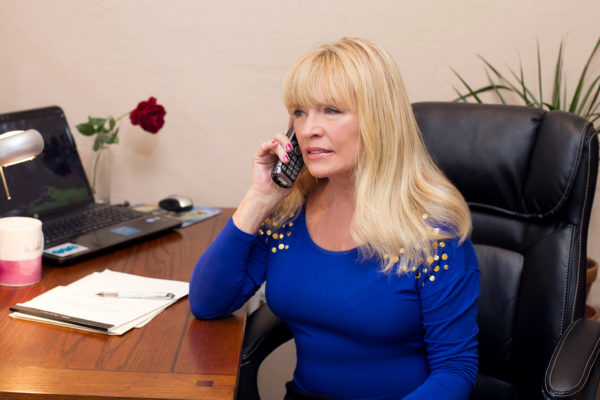

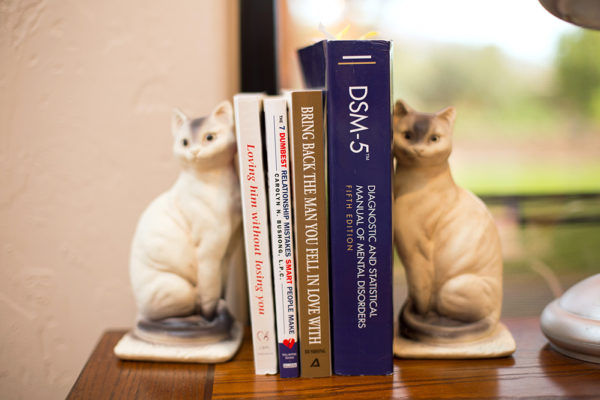
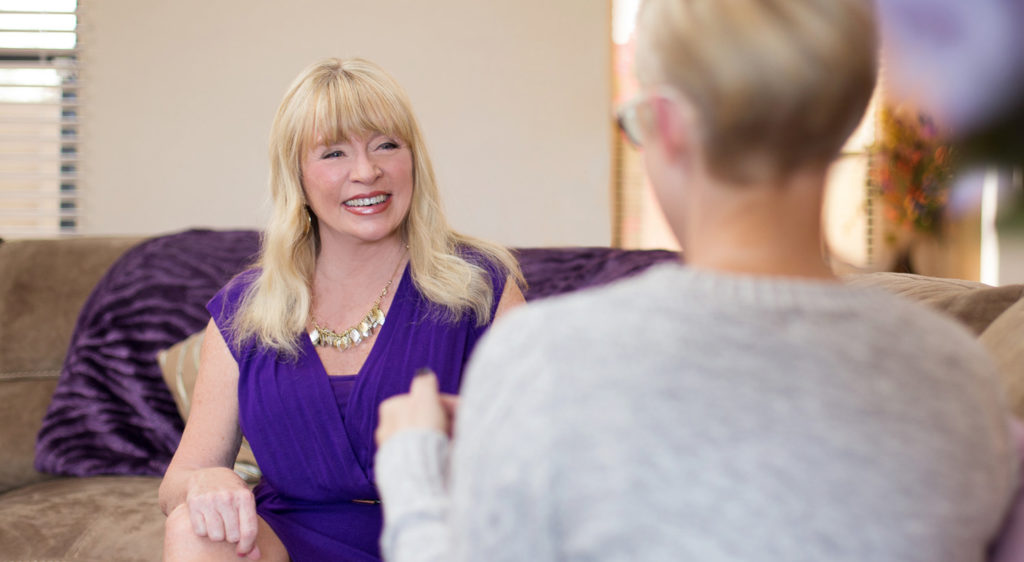
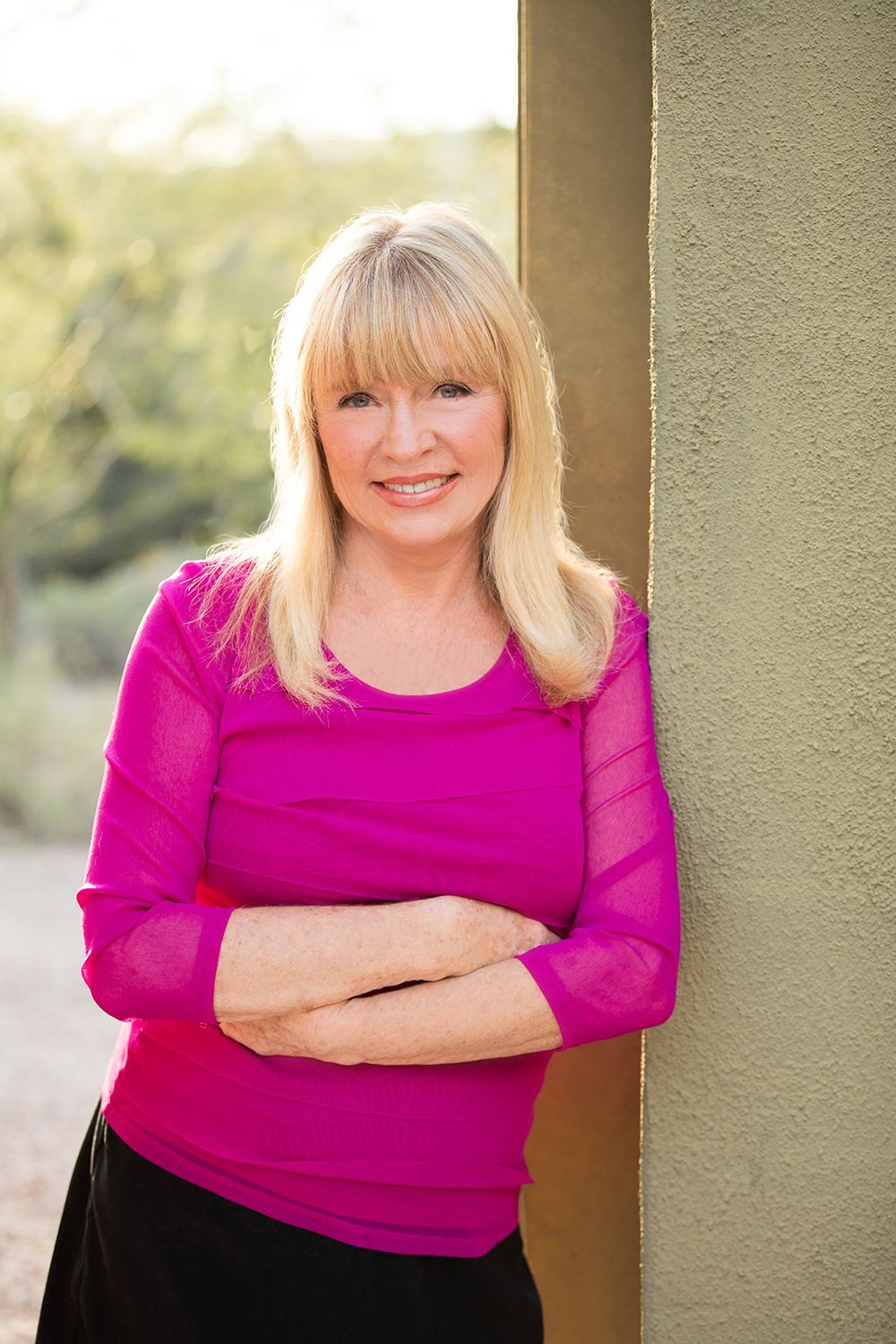
I am Carolyn Bushong and I am a Licensed Therapist with 30+ years’ experience.
As a licensed and skilled therapist, I have been called one of the nation’s top relationship experts (according to McCalls), I have helped countless people develop more satisfying and lasting relationships and I can help you too.
If you’re single, I can help teach you the dating skills you need to find that deep connection you’re looking for.
If you’re in a relationship, I can help you resolve issues to improve your connection.
If you’re struggling with life’s problems, I can help you work through personal dilemmas and provide direction through life coaching and/or psychotherapy.
Read more about me here.
I have been doing this for a long time and trust me, the rules of relationships don’t change. You might meet on Tinder and text rather than leave messages on an answering machine, but the wisdom and knowledge I have acquired throughout my career will always apply.
Praise from clients
- With your help, I was able to have this beautiful healthy union
Carolyn congratulated her on her marriage on Facebook and she replied back.
With your help, I was able to have this beautiful healthy union!!
~ CTE, East Coast
- You helped me heal the issues with my family!!
Thanks seems like an insignificant word to express my feelings for the help you've given me. The incredible healing that has taken place inside of me is due to your prodding and valuable insights. My relationship with my father is like I've been given a huge new facet to my life. This is more than a gift--it's just short of a miracle. Keep telling clients that it is worth enduring fear and pain to finally reach a resolution. Prior to this time I would never have believed that it was worth being so terrified to confront, to talk and to create a new relationship. When I lost my mother, I felt I'd lost everything regarding family. Now I have a parent again and the feeling of security that someone does really love and care about me is so incredible!
Thanks for being so smart and capable of helping.
~ Linda
- I confronted my family and found the man of my dreams!!
I wanted to first of all thank you for changing my life around. Your book was what initially inspired me--I related so much. I couldn't believe it, I felt like you were following me. Anyway, it was the counseling that truly turned my life around. I like your way of counseling. You are so direct...you don't caretake and you don't support client dependency. Basically, you don't encourage the "woe is me" attitudes. You were aware of the sickest relationship I've ever had. God, I look back now and can't believe I was in it as long as I was: I probably still would be, had I never called you. I still get upset when my mother drinks but I don't let it eat me alive like it did. She is a very weak person and I can't change that. Confronting my father in your office was something I never thought I could do. I love & respect my father very much...as a father...he truly knows how badly he screwed up in his "discipline" techniques. Anyway, last you knew I was dating "5" guys and calling the shots. I finally felt good about myself and when it rained it poured! I am getting married in 4 months--we just celebrated 1 yr. 4 mo. anniversary.
~ Tammy
- Thanks for letting me know men have rights too!!
For years I've carried around the article you wrote about men's rights. When I read it, I thought, "Finally a woman who understands me." That's what brought me into your office. Thanks for your help in straightening out my life!
~ Roger, Denver, CO
- You taught me to set boundaries – on Donahue!
It was great meeting you and speaking with you on the Donahue Show "My Husband Embarrasses Me In Public". What you said about establishing and respecting boundaries was absolutely true--and fortunately, we've managed to work things out (with some fighting, to be sure), much love, and a lot of fun. As for rebellion--yes, again! Bob has always been somewhat of a rebel, conforming to the 9 to 5 routine at work, and enjoying life at other times. Of course, Bob is still muttering that he's not "in denial" whereupon I just giggle! Many of my friends, and family, who watched the show thought you were terrific, and what you said made a lot of sense, and Bob and I agree--so again, it was great meeting you, and getting that brief analysis!
~ Barbara, Clifton, NJ
- Thanks for your help with personal growth, relationships and my children!!
Carolyn Bushong is the best and the brightest of therapists nationwide! I enjoyed my incredible learning experience with her. The people Carolyn meets and works with always have an exciting, challenging and wonderful experience.
~ Marion, Fashion Designer , Syracuse, NY, Aspen, CO, Stowe, VT
- Thanks for the strength to leave!!
All of a sudden my life has turned around. After meeting with you I was finally able to leave. I've moved into my apartment and filed divorce proceedings. It's nervy and scary, but I feel refreshed, excited and inspired. I want to thank you! I've told everyone I know how much you have helped me. In only two sessions you gave me the courage to do what I've been wanting to do for some time now. You are a wonderful woman.
~ Tammy, Denver, CO.
- You gave me the courage to leave my cheating husband!
I have you to thank Carolyn for where I am today. I may not have left my husband who cheated on me, but I'm stronger now and I think differently...I don't trust the same way because of what you have taught me. Now, because of his cheating, I have a small savings account of my own, some credit cards of my own, and I go out with my girlfriends at anytime -- not only when he is busy. One week he sat alone three nights on the couch in the same spot that I sat in for all of the years he was playing around on me. Now I've told him for every night he goes out I go out!
What is amazing to me is that the turn-around was when I confronted my Mom. I was extremely skeptical of your writings and encouragement in counseling to confront my parents. I didn't get it...I so get it now. (Now I'm just worried about our kids confronting us some day.) I get it that as long as I couldn't confront my parents about how they treated me, I couldn't confront my husband about his bad behavior either. But now I can!! And I do!!
He is treating me really well now, and I'm staying with him for now, but don't worry -- I am not naïve enough to think things will be like this forever. I have the name of a private investigator and will use it if and when I need to.
"Will he ever really grow and change the way he needs to?" Probably not. However, you helped me to grow and become a woman when much of my psyche was still a teenager. I was always waiting for my "man to make me happy," and of course, I continued to be disappointed. I never realized I was that dependent on him, but I was. Now, what he does is sort of irrelevant since I'm so happy with who I am. It is so "freeing" to finally believe in myself, and I thank you for that Carolyn ....always.
~ D
- Thank God for your book on relationships!!
Hi Carolyn: I’m 23 and I literally just read your book last night. Lately my boyfriend and I have been butting heads and losing the key elements that have always kept our relationship going. We have been through a lot. I know relationships have their ups and downs and everything’s not always going to be lovey dovey and sugar cookies......but I have a bad habit of saying things like "if it was meant to be, then things wouldn’t be this hard." He is a workaholic who considers quality time together doing chores or hanging out with others. He is a good man and I know I’m a good woman but we are both stubborn and tend to let outside factors come into our relationship and cause turmoil with us. So last night I was sure I had had enough...I went to the bookstore and looked at relationship books but a lot of them were too technical or didn’t relate to me in a way that caught my attention....then I found your book. I started to read a little and then it had my full attention. I stayed at the bookstore for 4 hours and read your entire book! I bought it and started highlighting parts pertaining to me and or my boyfriend. Your book pointed out a lot without being harsh or so technical that I needed a dictionary. It was down to earth and just real! Even though it’s an older book, it pertains to me so much right now in my life! I told my boyfriend and he said he would read it. So we decided to read it and then sit down with clear open minds and talk about what pertains to us, pertains to the other and affects our relationship. I’m hoping that him reading it will open his mind as well and show him that we are human and that we will make it and that things really aren’t that bad because everything can be fixed and actually become better! We have already gone through the hardest things and I hope we can get back to the love that has kept us together! THANK YOU! Your book has made me feel so much better! I am recommending this book to all my girlfriends! single, married or in a relationship...it can all apply! You are definitely a woman who knows what she is doing and knows how to reach people.
~ KC in Kennesaw, GA
- Thanks for helping me end that relationship!
When my girlfriend (of 6 months) broke up with me a few weeks ago, I got so upset I couldn't focus on work or much of anything. Then I called you and you helped me understand what happened - that once again I gave too much in this relationship and got taken advantage of. After we talked, I was able to see clearly and handle her in a healthy way and still feel good about myself. Thanks so much! I'm so glad you're in my life!
~ Enrique, Denver
- You literally saved my life!!
Carolyn, I owe you a huge thank you, and possibly my life. Thank you for always being there, for always calling when you received my desperate phone calls (which were often and many), and thank you for always calling just to check in on me. You have been a very strong constant for me the past 6 years, which has been longer than a lot of people who I thought “loved” me. I am very grateful to your professionalism, your expertise and your personal care in my life. You have helped me through so many bad relationships, staring with that A-hole who left me for ex-cheating wife who treated him like crap. His “choice” devastated me. And you picked up the pieces. You made me realize that it was not the men that I dated, but the core problem was my Father and how he always chose my middle sister, who is a convicted felon and overall bad, negative person and a user. My constant question was why were people choosing such bad, hateful, and using people over me? My family, friends and boyfriends were doing it over, and over. You made me realize that I was too much of a giver, too much of a “people pleaser” with no one giving back to me. Thank you for helping me to become stronger, to know my boundaries with my friends, family, boyfriends and coworkers. Thank you for always making me laugh, even though there were times I just wanted to give up on life all together. You were always digging and digging into the reason why I felt so deprived of love and why people could not see me for the great person I am! Screw them! I finally got it and I know I am a great person, sister, daughter and a friend to those who deserve it. For those who deserve me!
I am still going through so much in life, but I am a better person, mentally and emotionally, thanks to your help! I recommend you to all my friends and warn them that if they are scared of the truth and want to be “babied”, then they better not see you. That you will tell them how it is and you are not the therapist who only says “how does that make you feel?” Well, you already know that people must feel like crap, if they need to have someone else to talk to about their personal life. People constantly make people feel bad, just to lift themselves up. I am guilty of it as well. But with your help, I truly believe I am a better person and I have a better understanding of my worth.
Thank you for everything! Your friend and ongoing patient, because no matter what, I will always need you.
~ M., Denver
- You saved our relationship!
I just wanted to call you and thank you for everything you've done for us as a couple and let you know I really appreciate you!!
~ A.B., Parker, CO
- Thanks for the great dating advice!
You are amazing and I appreciate your aggressive therapy. There may be hope for me yet. :)
~ L, Denver
- Now I’m a better parent!
Just thinking of what a better father I have become since you're helped me regain much-needed focus. The boys and I just had two productive, enjoyable and very affectionate evenings together this week. Just an idea but:
I treated my two children to a great night out to dinner last night to one of their favorite restaurants. We talked about school (a little), their friends (a little more) and the fun that the three of us have all rediscovered in recent months. Carolyn, thank you for helping me focus on the importance of the beautiful gifts I have in my life." Can't stop smiling this morning and I hope you and Alan have a great weekend.
~ W, Denver
- Thanks for your help with my personal growth.
Carolyn – the Gardener! Carolyn helps her clients grow new eyes so that they can see the world in healthier ways!
- It’s time men stand up and say no!
For ten years I've had an article of your which I had framed that appeared in the Rocky Mountain News titled "It's Time Men Stand Up and Say No!" This article touched me in a way no one else ever has, and in fact, influenced me to go back to school and get a degree in psychology. I am now an L.P.C. with my interests in career and men's issues.
I just wanted to say thanks--you're doing good stuff (especially for men), and my respect and congrats for everything you have done. You use your life very well!
~ BVG
- I’m now handling rejection and confronting abusers!
You probably have no idea how important the insight and guidance you've provided has been. In the few times we met there was, each time, an important insight that will help me for the rest of my life. Most recently it was that I need to watch being "under" sensitive to abuse and "over" sensitive to rejection. Also, when you said it was insulting to me for my mother to not believe I have my own answers and know what it is I need to talk about--was very helpful.
I also want to thank you for being the kind of person you are--honest, forthright, direct, warm, kind. I had been to 2 therapists before you, one I went to 5 times and one I went to 2 times and no one helped me like you did. I got that genuine feeling from you right away--and I'm forever grateful.
~ Kate, Chicago, IL
- You’re a great dating coach!
Response to “Mr. Big” Story”: I want you to know that your free relationship newsletters have helped encourage me to start dating again. I’ve been divorced for 5 years and am in my forties. I’m learning how not to be so needy, nor to discuss too much during the first few meeting times, and not be so quick in desiring a relationship. I really enjoyed the advice you gave Sandy regarding her “Mr. Big.” There is so much for me to learn in this dating game. I appreciate that you have given us the permission to say what we want or need in a relationship before it goes on too long or without winning or expecting them to know what we want! And just because there’s a recession, it does not push me towards wanting or needing a man. And more so, I would not take back my ex for all the money in the world!!
~ J
- Thanks for making me strong and helping me move on in life!
It has been over 20 years since we first met and I joined your group therapy. I was trying to adjust to single life after a 35-year marriage. Relating to the other women in the group was vital to me and the journaling was the final solution. I woke up one night at 1am and began writing furiously, page after page, and finally felt strong enough to leave group. For some time after that, I revisited the journals to give me strength. One day I realized I had no need to read them anymore so I called my sister-in-law and we went to a campground in the foothills. It was a beautiful fall day with just a bit of ice on the edges of the little stream to give us notice that winter was on his way. Page by page we burned the journals and with the smoke released them to the universe. I felt a profound sense of peace and I could go forward to embrace the rest of my life – and now I’m 81-years-old!
Thank you Carolyn!
~ NK
- Love your newsletter
Love your newsletter and all your wonderful advice! Thanks for all the good you do. Longtime reader,
~ Shelley
- I believe your book should be taught in school
My name is Lavinia and I am 31. I am a translator and I discovered your book recently . I believe it should e taught in school…..as part of LIFE education! I recommend it to all my friends and EVERYBODY in the world! Thank you for existing and helping us. I would love to help you translate it into other languages so the whole world will get your message!
~ Lavinia
- BEST Therapist in the WORLD!!!!
Happy Birthday to the BEST therapist in the WORLD!!!! Hope your day is as sensational as YOU are!!
~ Tammy
- You helped me and my son!
My son and I talk frequently about how much we learned from you about communication and setting boundaries. Thank you for helping both of us to be healthier in all of our relationships.
- You turned my life around!
I wanted to thank you for changing my life around. Your book was what initially inspired me--I related so much. I couldn't believe it, I felt like you were following me. Anyway, it was the counseling that truly turned my life around. I like your way of counseling. You are so direct...you don't caretake and you don't support client dependency. Basically, you don't encourage the "woe is me" attitude, and I totally appreciate what you did for me.
~ Joe, Castle Rock, CO
- You gave me courage!
I wanted to let you know that my father finally caved after 1 ½ years of me setting and holding my boundaries. I never backed down and I made him look at what he said and did to me. We’ve wiped the slate clean and I feel so free on so many levels. Even my husband is starting to come around. I feel so relieved! I held on, and now I just need to shine some more brass balls in other areas of my life and I’ll be fine. I just wanted to let you know how much I appreciate you as a counselor. You helped me so much!!
~ M.T., Tennessee
- You raised my self-esteem!
Words alone are insufficient to express my gratitude towards you. Your advice and concern over the past couple of years gave me the tools to acquire what I have now: a wonderful, satisfying, secure life. I am pleased with myself, my looks and my career. I used your advice about relationships to end an unhealthy one, and I've used your advice to ready myself for a happy, productive, fulfilled life, with or without a man.
Thank you a million times over. You helped me find within myself an entirely new and better person. What a gift! I am so lucky to know you.
~ Ricki, Thornton
- Thanks for your help with personal growth, relationships and my children!!
Carolyn Bushong is the best and the brightest of therapists nationwide! I enjoyed my incredible learning experience with her. The people Carolyn meets and works with always have an exciting, challenging and wonderful experience.
~ Marion, Fashion Designer , Syracuse, NY, Aspen, CO, Stowe, VT
- You’re the best therapist!
I want to thank you for being the kind of person you are--honest, forthright, direct, warm, kind. I had been to therapists before you and no one helped me like you did. I got that genuine feeling from you right away--and I'm forever grateful.
~ Sue, Indiana








SIGN UP FOR CAROLYN’S FREE NEWSLETTER

Watch Carolyn on Oprah!
Meet Carolyn

Anyone who knows me already knows that what separates me from other therapists is my ability to assess your situation quickly and give you clear, direct, substantial advice. You will get valuable information on how to change … [Read More]